
Picture day is at nine in the morning. The shirt gets a smear of something at eight forty. That photo is going on a wall for a decade.
Field day is the same problem in reverse, where you know in advance that everything is going to come home destroyed and the only question is how much of it survives.
Neither situation calls for anything exotic. What they call for is having the right four things within reach and knowing the two rules that decide whether a stain comes out.
The two rules
Everything below is built on these.
Blot, never rub. Rubbing spreads the stain outward, pushes it deeper into the weave, and breaks fibers, which leaves a permanent fuzzy pale patch even after the color is gone. Press a clean cloth onto the mark, lift, move to a clean part of the cloth, repeat.
Work from the outside inward. Starting at the center pushes the stain out into clean fabric and makes a small mark into a large one. Start at the edge and move toward the middle.
And the rule underneath both: heat sets almost everything. No hot water, no hair dryer, no putting it in a dryer until you have looked at the fabric dry and confirmed the mark is gone.
The kit
Four things, in a zip bag, in the car. This is the whole thing.
A stain remover pen or wipes. The commercial ones are genuinely good for the first thirty seconds after a spill, which is when most stains are actually beatable.
A small bottle of liquid dish soap. This handles every oil-based stain, which is most food stains, and it outperforms most laundry pretreats on grease.
Cotton pads and a clean white cloth. White, so you can see what is lifting and so no dye transfers into the garment.
A small bottle of water. Half of stain treatment is rinsing, and there is not always a sink.
Optional and worth having: a lint roller, a couple of safety pins, and a Tide-type pen for the car specifically.
Morning-of triage, by stain
What you have is a few minutes and no washing machine. The goal is not to finish the job, it is to keep the stain treatable until you get home.
Food grease, pizza, butter, salad dressing. Blot up what is sitting on the surface. Put a small drop of dish soap on and work it in gently with a fingertip. Blot with a damp cloth. Do not soak the area. If nothing else is available, cornstarch or baby powder pressed onto the mark absorbs oil and brushes off, which buys you hours.
Chocolate and ice cream. Scrape the solid off with something dull. Cold water only, because these contain protein and heat cooks it in. Blot from the back.
Juice, sports drink, soda. Dye stains. Cold water immediately and a lot of it. Blot, do not rub. The red and blue ones need a proper soak at home.
Ketchup and barbecue sauce. Scrape, then cold water from the back of the fabric, then a little dish soap. Never hot, since tomato sets with heat.
Marker and ink. Hand sanitizer works and everyone has it. Put a dry cloth underneath to catch what comes through, dab with sanitizer on a cotton pad, and change the cloth underneath as it picks up ink. Blot rather than rub or you spread it.
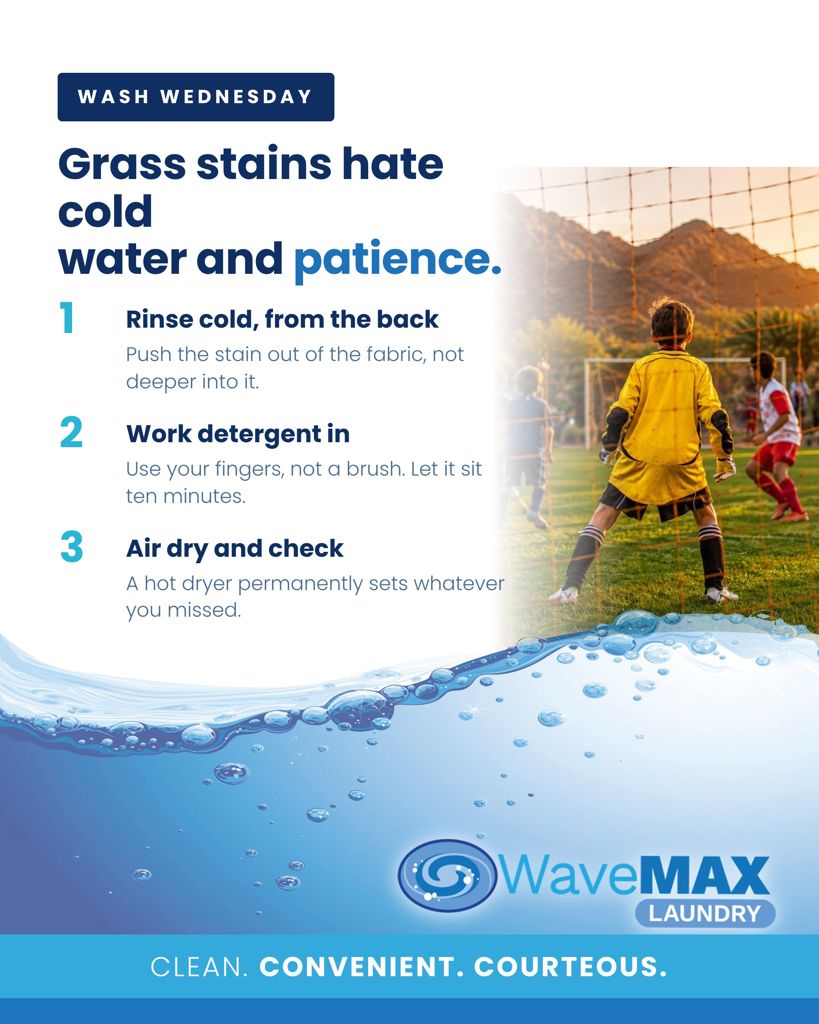
Grass, from a recess before the photo. Cold water, a little detergent or dish soap worked in with a fingertip, and time. Grass genuinely needs contact time, so this one is mostly a hold-the-line job until you get home.
Blood. Cold water only, always. Hydrogen peroxide works on white and will lift color out of anything dyed. Keep blotting with cold and change cloths.
Mud. Do nothing. This is the one where the correct action is to leave it alone and let it dry so it can be knocked off later. Rubbing wet mud is how a spot becomes a haze.
Tricks for the ten minutes before a photo
Sometimes the goal is to make it invisible for an hour rather than to remove it.
A stain on a printed or patterned shirt is much less visible than one on a plain one, which is an argument for the patterned shirt on picture day.
Cornstarch or baby powder on a fresh oil stain hides it well while it absorbs. On light fabric it disappears into the color.
A lint roller fixes more picture day problems than stain remover does. So does turning a collar down properly and smoothing a shoulder seam.
Chalk, white on light fabric, will cover a small mark for a few hours. It brushes out and washes out.
Bring a spare shirt. Not a trick, just the answer. Picture day and field day both justify a second shirt in a bag, and it solves the problem completely in the cases where nothing else will.
Field day, which is planned destruction
Different mindset. You know what is coming.
Send clothes you have already decided are expendable. Field day is not the day for the good shorts.
Old clothes still deserve treatment, because grass and mud on something that gets worn all summer is still worth saving.
Send a plastic bag for anything soaking wet, and pack a full change of clothes.
Sunscreen is worth knowing about: the chemical kind containing avobenzone reacts with minerals in water and leaves orange marks that appear during washing rather than on the field. Treat those with white vinegar, never with chlorine bleach, which sets them permanently.
What to do at home that night
Every stain treated in the field is a holding action. The real work happens the same evening.
Treat again properly, with the right approach for that stain type, and give it fifteen minutes of contact time rather than rushing it into the machine.
Wash cold unless the stain is oil, which wants the warmest water the tag allows.
Air dry and look at it in daylight before it goes anywhere near a dryer. This is the step that decides whether the garment survives, and it is the one people skip when it is late.
If a mark is still there, treat and wash again. Two or three passes handle almost anything, and none of them work after a dryer cycle.
Where the machines help
Field day usually generates one enormous load of wet, muddy, grass-stained clothing that all needs a soak, and a soak is what household machines do worst. The drum holds a limited amount of water, so everything sits packed against itself and the solution never moves through the middle.
The machines at our self-service laundry on Main Street hold considerably more water and give a full load room to tumble, which is what an oxygen bleach soak and a proper rinse both need. For the aftermath of a field day, doing it in one pass rather than three is the practical difference.
Nuestro wash-dry-fold service covers the everyday laundry if the school calendar has the household behind.
The short version
Blot rather than rub, and work from the outside of the mark inward. Heat sets nearly everything, so no hot water and no dryer until you have checked the fabric dry in daylight. Keep dish soap, a stain pen, a white cloth, and water in the car. Oil stains want dish soap, dye stains want cold water fast, ink wants hand sanitizer with a cloth underneath, blood is cold only, and mud should be left alone to dry. Bring a spare shirt on picture day, because it solves the case nothing else will.
WaveMAX The Colony is at 6805 Main St, easy to reach from The Colony, Little Elm, and the surrounding area. If something came home from a field day and you are not sure it can be saved, call us at (469) 200-8400 and describe it.