
Mud and grass show up on the same pair of pants, on the same afternoon, and they need opposite treatment. Get them backwards and you set one of them permanently.
North Texas soil makes this worse than most places. The clay here holds color, it holds water, and it grinds into fabric in a way that ordinary garden dirt does not. Anyone who has washed a football uniform after a wet Friday in Arlington knows the difference.
The rule that surprises people
Let mud dry completely before you touch it.
Every instinct says to rinse it off immediately. That instinct is wrong, and following it is the most common reason a muddy uniform stays stained.
Wet mud is a suspension of fine particles in water. Rub it or rinse it while wet and you push those particles deep into the weave, spreading a defined patch of mud into a large gray-brown haze that will not come out.
Dry mud is brittle. It cracks, and most of it falls off as dust before water ever touches it. You remove eighty percent of the problem mechanically, which leaves a much smaller job for the detergent.
So: hang the item somewhere it can dry. Outside, in the garage, over a rail. Do not put it in a hamper wet and do not put it in a machine.
Removing dried mud
Once it is fully dry, take it outside and knock the bulk off. Bend the fabric so the crust cracks, then brush the loose material away with a stiff brush or the edge of a dull knife.
Vacuum the residue if it is a heavy item like a jacket. Sounds fussy, works well.
Then soak in cold water with detergent for fifteen to thirty minutes before washing. Cold, because the clay here carries iron and organic material that heat can set.
Wash on the longest cycle you have with an extra rinse. The extra rinse matters more than the detergent amount does, because you are carrying away suspended particles rather than dissolving anything.
Why clay is its own problem
Red and orange clay stains are more than soil. The color comes from iron oxide, and iron oxide behaves like rust rather than like dirt.
That means two things.
Never use chlorine bleach on a clay stain. Chlorine oxidizes iron and sets the color permanently. On a white uniform this is the single most expensive mistake, and it is exactly what people reach for.
Acid works where detergent does not. White vinegar, lemon juice, or a fabric rust remover will lift iron staining. For a stubborn orange mark, make a paste of cream of tartar and water, work it in, let it sit an hour, then wash.
Oxygen bleach is safe on clay and is the right choice when a whole item needs brightening.
Now the opposite: grass
Everything above is wrong for grass.
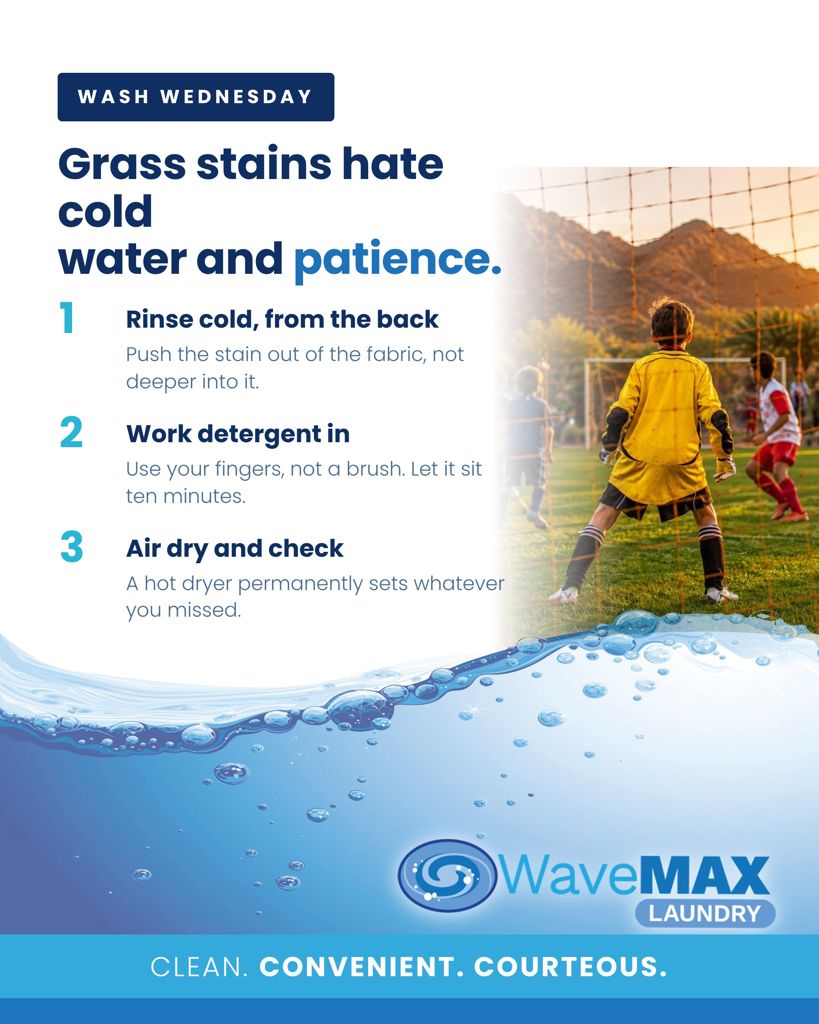
Grass is a pigment that bonds to fiber, so there is nothing to let dry and knock off. Waiting only gives it more time to set. Grass wants treatment as soon as possible, cold water, detergent worked in with your fingers, and fifteen minutes of contact time before washing.
So a pair of pants with both needs a sequence rather than one treatment:
1. Let the mud dry and brush it off.
2. Treat the grass spots with detergent, cold, and let them sit.
3. Soak the whole thing cold.
4. Wash cold with an extra rinse.
5. Air dry and inspect before any heat.
It takes an evening rather than twenty minutes, and it is the difference between a uniform that lasts the season and one that gets replaced in October.
The other stains that come home in the same load
Blood, from a scraped knee or a bloody nose. Cold water only, always. Hot water cooks the protein into the fabric and makes it permanent. Rinse cold, then soak cold with salt or with hydrogen peroxide on white. Peroxide will lift color from dyed fabric, so test it first.
Field paint and chalk lines. Usually lime based and mostly mechanical. Let it dry, brush it off, then wash. Do not scrub it in wet.
Sports drink. Dye plus sugar. Cold rinse right away, then treat like a dye stain with detergent and time. The blue and red ones are the worst.
What kills uniforms faster than the stains do
Two habits, both easy to change.
High heat drying. It destroys the elastic in waistbands, breaks down the printed numbers and logos, and shrinks anything with cotton in it. Uniforms want low heat or a hanger.
Fabric softener on performance fabric. Softener coats fibers in a water-repellent film. Athletic fabric is engineered to move sweat away from the body, and the coating stops it doing that. It also traps odor in the coating, which is why gear that gets softened every wash eventually smells no matter what.
Skip both, and add half a cup of white vinegar to the rinse instead.
Where a home machine runs out of room
The real constraint on a muddy load is water volume. You are trying to carry clay particles out of the fabric and away, and a household drum holds a fixed and fairly small amount of water. Pack it with a full set of uniforms and the same sediment circulates through the load for the whole cycle, then settles back in.
The machines at our self-service laundry on West Park Row Drive move considerably more water per cycle and have the drum size for a full set of uniforms to tumble freely. For mud specifically, water volume is the entire mechanism.
Our wash-dry-fold service covers uniforms and household laundry if a season has gotten ahead of you.
The short version
Let mud dry completely and knock it off before water touches it, because rinsing wet mud grinds it into the weave. Cold water throughout, long cycle, extra rinse. Never chlorine bleach on red clay, since it sets the iron permanently. Grass is the opposite and wants immediate treatment with detergent and fifteen minutes of contact time. Blood is cold water only. Skip fabric softener on anything athletic, and keep uniforms out of high heat.
WaveMAX Arlington is at 2823 W Park Row Drive, easy to reach from Arlington and the surrounding area. If a uniform came home worse than usual and you want to know what to try first, call us at (682) 323-4466.