
White sneakers are a school uniform requirement in some places and a personal standard in others, and either way they last about three weeks before they stop being white.
Shoes are harder than clothing because you cannot treat the whole thing the same way. A sneaker is canvas, rubber, foam, glue, and sometimes leather, all attached to each other, and the method that works on one part damages another.
Identify the materials first
Look at what you actually have before you start.
Canvas is woven cotton. Durable, washable, tolerates scrubbing and soaking.
Synthetic mesh on athletic shoes is more delicate and it does not like aggressive brushing, which frays it permanently.
Leather and synthetic leather want wiping rather than soaking. Water dries them out and cracks them.
The rubber midsole and toe cap take almost anything.
The glue holding it together is the weak point, and it is why heat and long soaking are both risky.
Grass on canvas
Same chemistry as grass on a shirt, harder mechanics because you are working on a curved surface you cannot turn inside out.
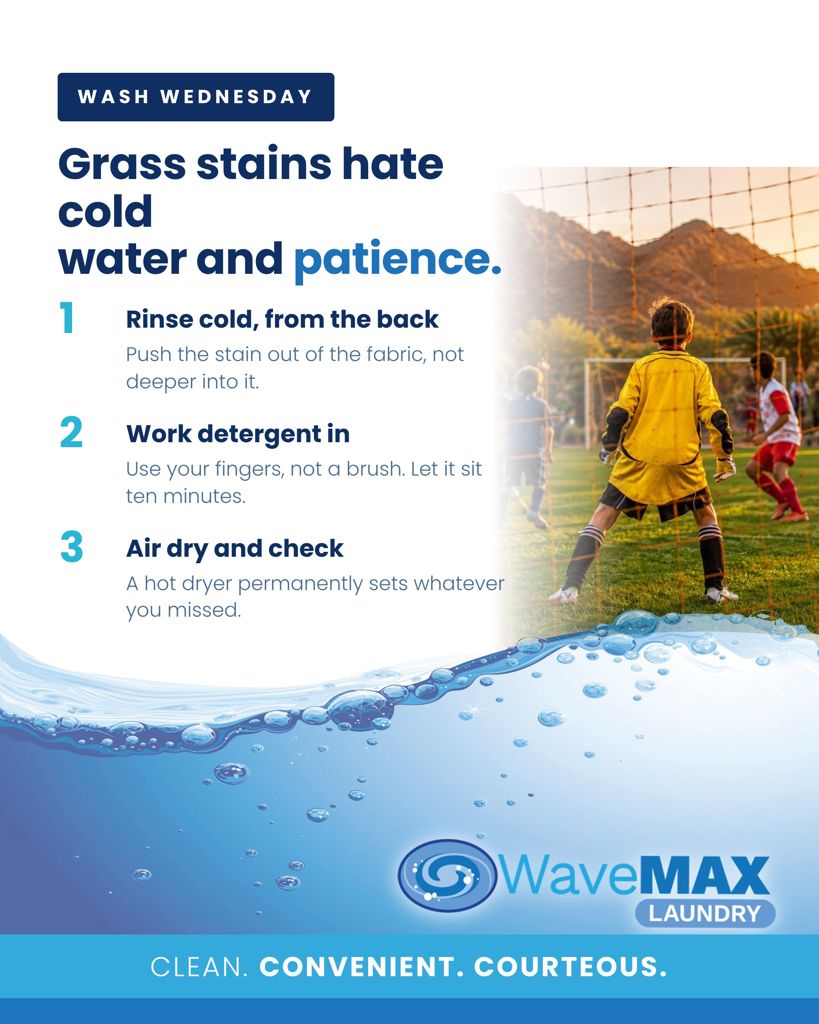
Grass is chlorophyll, which is a pigment bonded to the fiber rather than dirt sitting on top, so scrubbing harder does not help and cold water is the rule. Heat sets it.
The method: wet the area with cold water. Work liquid detergent into the canvas with an old toothbrush, gently, in small circles. Let it sit fifteen minutes, which is the part that does the actual work. Rinse with a cloth and cold water. Repeat rather than scrubbing harder.
For a stain that resists, rubbing alcohol on a cotton pad dissolves chlorophyll directly. Test on the inside of the tongue first, since alcohol can lift dye from colored canvas.
Never chlorine bleach on grass. It reacts with the plant compounds and turns the mark yellow, which on a white shoe is worse than green.
Everything else that gets on a white shoe
Red clay, which is unavoidable around here. This is iron oxide and it behaves like rust. Let it dry completely, knock and brush the loose material off, then treat with white vinegar or a paste of cream of tartar and water rather than detergent. Never chlorine bleach on clay, which sets the iron permanently.
Mud. Let it dry. Rinsing wet mud grinds the fine particles into the weave and turns a spot into a haze.
Scuff marks on the rubber. A magic eraser takes these off in seconds. Keep it on the rubber only, since it is a fine abrasive and it will dull canvas and remove printed logos.
Yellowing on white rubber. This is oxidation from sun and air rather than dirt. A paste of baking soda and a little hydrogen peroxide, worked onto the rubber, wrapped in plastic wrap, and left in sun for a few hours works well. Rinse afterward.
Blood from a scrape. Cold water only, always. Hydrogen peroxide on white.
Oil and asphalt. Dish soap worked in, warm water, patience.
The washing machine question
You can machine wash canvas sneakers and it is a tradeoff rather than a rule.
What it costs: agitation stresses the glued seams, and repeated machine washing shortens the life of the shoe.
What it gains: it is fast and it does a genuinely thorough job on canvas.
If you do it: remove the laces and the insoles and wash those separately in a mesh bag. Knock off all loose dirt first. Put the shoes in a pillowcase or a mesh bag, add a couple of towels to cushion the drum, and run cold on gentle with a small amount of detergent.
Never the dryer. Heat separates the glue, warps the shape, and shrinks canvas. This is the mistake that ruins shoes.
Leather, suede, and shoes with lights or electronics never go in a machine.
Drying, which decides whether they stay white
Stuff them with white paper towel or white paper. Not newspaper, which transfers ink into damp canvas.
The paper holds the shape and pulls moisture out from inside. Change it after an hour.
Dry at room temperature with air movement. A fan helps. Direct sun is fine and even useful for white canvas, since sunlight bleaches it, but keep colored shoes out of it.
Expect a full day, more in humidity. A shoe that feels dry outside can still be wet in the foam, and putting a damp shoe back on is how the smell starts.
Never a dryer, a radiator, or a heat vent.
Laces and insoles
Laces are the fastest visible improvement. Take them out, soak them in warm water with detergent and a little oxygen bleach, work them between your fingers, rinse, and air dry. Or just buy new white laces, which costs almost nothing and makes a shoe look new.
Insoles are where the smell lives. Hand wash in warm soapy water, rinse thoroughly, dry completely. Never in a machine or a dryer, because the foam breaks down.
For persistent odor, baking soda inside overnight, or a sealed bag in the freezer, which kills the bacteria without heat.
Keeping them white longer
Treat marks the day they happen. A fresh mark takes two minutes and a three-week-old mark takes an hour.
A fabric protector spray on new canvas shoes genuinely helps and needs reapplying every few weeks.
Wipe the rubber down weekly. It takes a minute and it is most of what makes a shoe look cared for.
Two pairs alternated last more than twice as long as one pair worn daily, because each pair gets a full day to dry out.
Where the machines help
The part that reliably fails at home is the soak. Laces, insoles, and a set of white socks all want a long oxygen bleach soak, and a household drum holds a limited amount of water, so the solution sits packed rather than circulating.
The machines at our self-service laundry on The Plaza hold considerably more water and give a load room to move, which is what an even soak and a full rinse require. The larger drums also cushion a pair of canvas shoes far better than a packed household machine does.
Our wash-dry-fold service covers the everyday laundry if a school week has the household behind.
The short version
Work out what the shoe is made of first, because canvas, mesh, and leather need different handling. Grass on canvas is a pigment, so cold water, detergent worked in gently with a toothbrush, and fifteen minutes of contact time, never bleach. Red clay is iron and wants vinegar, never bleach either. Let mud dry before touching it. A magic eraser fixes rubber scuffs in seconds. Never put shoes in a dryer, stuff them with white paper rather than newspaper, and give them a full day to dry.
WaveMAX Charlotte is at 2915 The Plaza, easy to reach from east Charlotte and the surrounding neighborhoods. If a pair has a mark you have already tried on, call us at (704) 910-1587 and describe it.