
School starts, and within two weeks every household with a kid in it is dealing with the same green smear on the knees. Grass season in Northeast Ohio runs from the first practice in August through the last game in October, and grass is one of the few stains that gets harder the longer you treat it like ordinary dirt.
The reason people fail at grass stains is that they are treating the wrong kind of problem. Almost everything else on a kid’s clothes is soil sitting on top of the fabric. Grass is not.
Grass is a dye, not dirt
The green in a grass stain is chlorophyll, and chlorophyll is a pigment that bonds to fibers. Alongside it are proteins, sugars, and other plant compounds that each behave differently.
The practical difference: dirt sits on the surface and can be lifted off with water and agitation. A dye has chemically attached itself to the fiber, and you have to break that bond rather than rinse it away.
Which is why scrubbing a grass stain harder makes it worse. You are not loosening anything. You are driving the pigment deeper into the weave and abrading the fabric while you do it.
It is also why cold water is the rule here. Heat helps set a protein and a pigment into fabric, and grass has both.
The three things that make grass permanent
Nearly every grass stain that never comes out was ruined by one of these.
Hot water. On most stains warm water helps. On grass it sets the protein component and locks the pigment in. Cold from start to finish, until the mark is gone.
The dryer. The single most common way a recoverable stain becomes permanent. A dryer cycle bakes what is left into the fiber and nothing brings it back. Never dry a garment until you have looked at it in good light and confirmed the mark is gone.
Chlorine bleach. The instinct on a white sock is to reach for bleach. On grass it frequently reacts with the plant compounds and turns the stain yellow-brown, which is worse than green and harder to remove. Oxygen bleach is the right tool.
What actually works
Order matters more than product here.
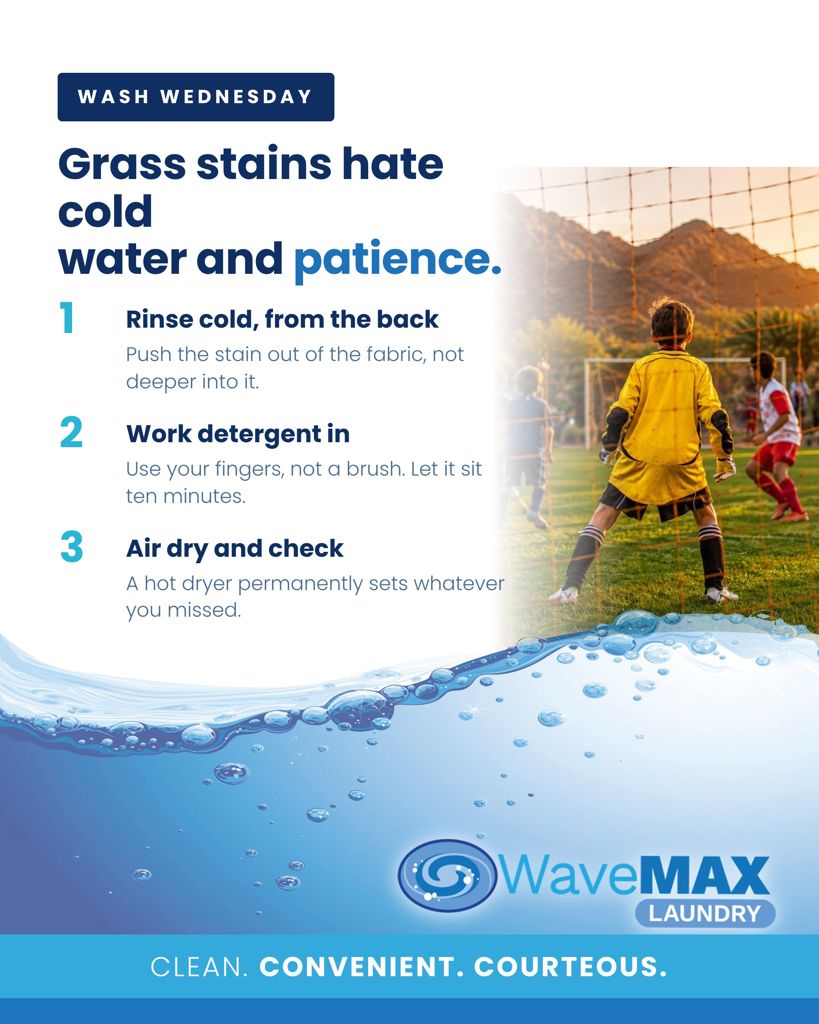
1. Rinse cold, from the back. Turn the garment inside out and run cold water through the back of the stain. You want to push the pigment out the way it came in rather than through the rest of the fabric.
2. Work liquid detergent into it with your fingers. Not a brush. Fingers give you enough friction to work detergent into the weave without breaking fibers, and broken fibers are what makes a permanent fuzzy pale patch even after the color leaves.
3. Let it sit ten to fifteen minutes. This is the step everybody skips and it is the one doing most of the work. Detergent needs contact time to break the bond between pigment and fiber. Rushing to the machine is why the stain is still there afterward.
4. Wash cold on a normal cycle.
5. Air dry and check. Look at it dry, in daylight. Wet fabric hides a faint stain completely.
6. Repeat if needed. Two or three passes will handle almost anything. Each round removes more.
When the basic method is not enough
For a stain that has been there a while, or on a heavy cotton uniform:
Enzyme detergent or a pretreat spray with enzymes. Enzymes break down the protein component specifically, and this is where they earn their place. Check the label for protease or “enzyme” in the ingredients.
White vinegar, one part to two parts water. Soak thirty minutes. The acid helps release the pigment. Works well on cotton and on white.
Rubbing alcohol dissolves chlorophyll directly, which is worth knowing. Dab it on with a cloth from the back of the stain, let it work a few minutes, then rinse cold and wash. Test on an inside seam first, because alcohol can lift dye out of colored fabric too.
Oxygen bleach soak. Dissolve in warm water, then let the item soak several hours or overnight. Safe on colors, unlike chlorine bleach. This is the best option for a whole uniform that is generally green rather than spot stained.
Grass on things that are not cotton
Polyester and performance fabric. Most sports uniforms. Polyester actually releases grass more easily than cotton does, because the pigment does not bond as tightly. Do not use hot water and do not use alcohol undiluted, which can damage some synthetic finishes.
Denim. Heavy and absorbent, so it needs longer contact time. Same method, more patience.
White canvas shoes. Same chemistry, harder mechanics. Detergent and an old toothbrush, worked gently, then rinse. Do not put canvas shoes in a hot dryer with a stain still on them.
Anything with a rubber or printed logo. Keep alcohol and heavy solvents off the print. Work around it.
A realistic system for a school year
The stain that gets treated within a day comes out. The one that lives in a gym bag until Sunday frequently does not.
Keep a bottle of enzyme pretreat where the bag gets dumped. Treating a knee takes ninety seconds if the bottle is right there and never happens if it is in a cabinet upstairs.
Do not hamper a wet or muddy uniform. Rinse it cold, wring it, and hang it until wash day.
Own two of anything worn twice a week. It is the difference between treating a stain properly and rushing it through hot because the game is tomorrow.
Where the machines matter
A soak is the strongest tool you have on set-in grass, and household machines are poor soaking vessels. The drum holds a limited amount of water, so a full load of uniforms sits packed and the solution never really circulates.
The machines at our self-service laundry on Libby Road hold considerably more water and take a full team’s worth of uniforms with room to move, which is what an oxygen bleach soak needs to work evenly. For a set of jerseys that all need the same treatment at once, that is the practical difference.
Our wash-dry-fold service covers sports gear and everyday laundry if a season is running you over.
The short version
Grass is a dye, so you are breaking a chemical bond rather than rinsing off dirt. Cold water only, never hot, never the dryer until the mark is confirmed gone, and never chlorine bleach because it turns grass yellow. Rinse from the back, work liquid detergent in with your fingers, and let it sit fifteen minutes before washing. Enzyme detergent, a vinegar soak, or rubbing alcohol handle the ones that resist. Check the garment dry and in daylight before it goes anywhere near heat.
WaveMAX Maple Heights is at 20980 Libby Rd, easy to reach from Maple Heights, Bedford, and the surrounding area. If a uniform has a stain you have already tried on and you want to know whether it is worth another round, call us at (216) 800-1900.