
Grass gets all the attention, and playgrounds are mostly not grass. They are wood mulch, engineered wood fiber, rubber, or sand, because those absorb a fall better than turf does.
Each of those leaves something different on clothing, and none of them behave like a grass stain. A parent who treats mulch the way they treat grass ends up with a permanent mark, and the reason is worth understanding.
Wood mulch, which is the most common
Most playground surfacing around here is wood, either bark mulch or engineered wood fiber.
Wood leaves three things behind, and they need different handling.
Splinters and fragments, which are mechanical. Let the garment dry, then shake it hard outdoors and brush it. Do not wash a garment full of wood fragments, because they end up in the machine and in the next load. Check pockets, cuffs, and the inside of socks.
Tannin staining, which is the yellow-brown mark left where wet mulch sat against fabric. Tannins are the same compounds that stain a mug with tea, and they respond to acid rather than to detergent. White vinegar, one part to three parts water, soaked thirty minutes, then washed. Lemon juice and sunlight works on white.
Importantly, chlorine bleach can turn a tannin stain darker, which is the opposite of what people expect. Oxygen bleach instead.
Ground-in dirt, which is whatever the mulch was lying on. Let it dry, brush it off, then soak cold before washing.
Sand
Sand is not a stain at all, and treating it like one is why it ends up everywhere.
Sand is abrasive. Left in fabric it wears fibers from the inside every time the garment moves, and in a washing machine it settles into the drum, the pump, and the filter.
Let it dry completely. Wet sand clings and smears. Dry sand falls out.
Shake and brush outdoors, then turn pockets inside out and do it again.
Vacuum stubborn areas, particularly cuffs, seams, and the inside of shoes.
Then wash with an extra rinse, which carries away whatever survived rather than letting it settle back into the fabric.
Check the machine filter periodically if sand is a regular feature of your laundry. Most front loaders have an access panel at the bottom front.
Rubber surfacing
Poured rubber and rubber mulch leave black marks that people misdiagnose as dirt.
They are oily. Rubber contains carbon and oils that transfer to fabric under friction, especially from a slide or a fall.
Which means the treatment is the opposite of the grass rule: oil wants warm water and dish soap, not cold water and detergent. Work liquid dish soap in with your fingers, let it sit ten minutes, then wash in the warmest water the tag allows. Cold water does very little to oil.
Rubber crumb pellets are mechanical, like sand. Shake them out before washing.
The stains that arrive with them
Playground clothes rarely come home with only one thing on them.
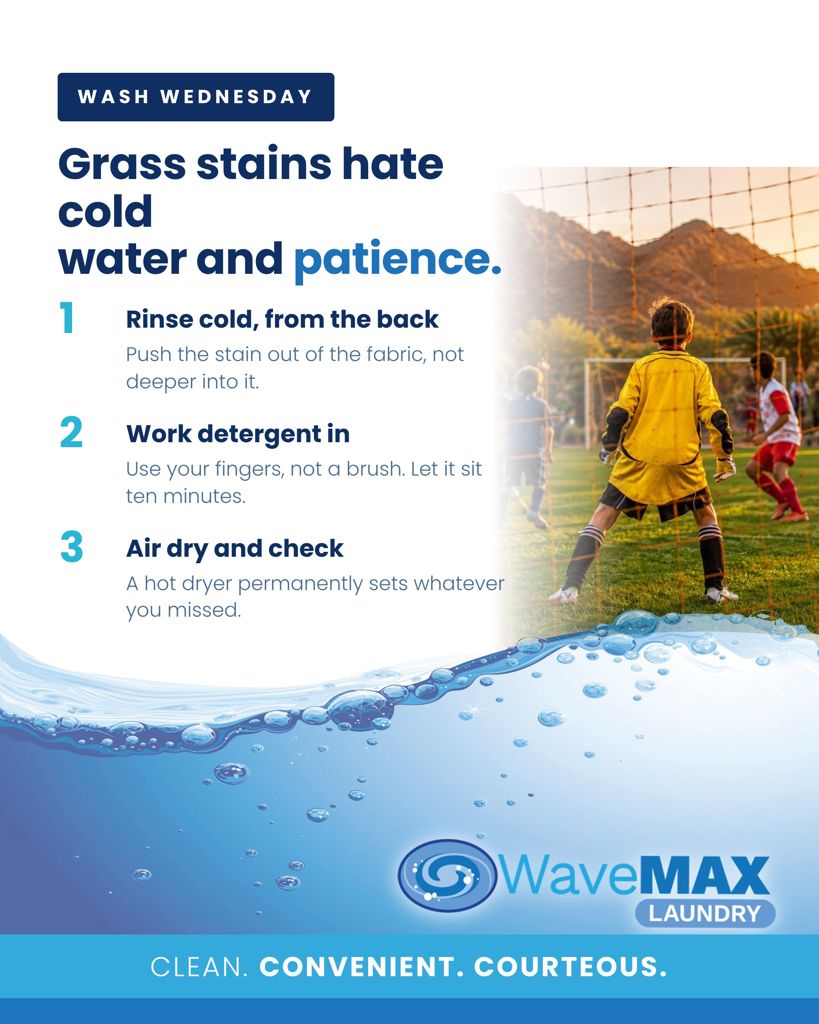
Grass, where there is grass. Cold water, detergent worked in with your fingers, fifteen minutes of contact time. Never hot, never bleach, never the dryer until it is gone.
Mud. Let it dry and knock it off. Rinsing wet mud grinds it into the weave and turns a spot into a haze. This is the exact opposite of the grass instruction, and getting them backwards is the most common mistake in kids’ laundry.
Blood from a scrape. Cold water only, always. Heat cooks the protein into the fabric permanently. Hydrogen peroxide works on white and lifts color from dyed fabric, so test first.
Asphalt and tar from a blacktop. An oil stain and a stubborn one. Dish soap, warm water, repeated. A little rubbing alcohol first helps.
Chalk. Brush it off dry. Most of it leaves without water at all.
The order that gets it all out
A garment with several of these needs a sequence rather than one treatment, and doing it out of order sets something.
1. Let it dry completely. Mud, sand, mulch fragments, and chalk all come off dry and smear wet.
2. Shake and brush outdoors. This removes most of the physical material.
3. Treat oil marks with dish soap, since those want warm and you want them handled before anything cold happens.
4. Treat grass and blood with cold water and detergent, with contact time.
5. Soak the whole thing cold if there is tannin staining, adding vinegar.
6. Wash with an extra rinse.
7. Air dry and check in daylight before any heat touches it.
It sounds long. It is about ten minutes of actual work spread across an evening, and it is the difference between play clothes lasting a year and lasting a month.
What to send a kid to school in
Some of this is solved at the closet rather than at the machine.
Darker colors and patterns for days with recess. Nothing hides a mulch stain like not being white.
Knees are the failure point. Reinforced-knee pants exist and they are worth it for the elementary years.
Play clothes and school clothes as separate categories, if the school allows it. The good shirt does not need to be on the playground.
Two pairs of shoes alternated, so one pair gets a full day to dry out and shed whatever is in it.
Where the machines help
Playground laundry is mostly a rinsing problem. You are carrying particles away, and a household drum holds a limited amount of water, so sand and grit circulate through the same load for the whole cycle and settle back into the fabric rather than leaving.
The machines at our self-service laundry on East Oak Street move considerably more water per cycle and give a load room to tumble, which is what actually carries grit out. Running heavily sanded or muddy clothes here also keeps that material out of the machine your bedding goes through.
Our wash-dry-fold service covers the everyday laundry if a school week has the household behind.
The short version
Playground surfaces are mostly not grass, and each one needs different handling. Wood mulch leaves fragments to brush off dry plus tannin stains that want vinegar, and chlorine bleach makes tannins darker. Sand is abrasive rather than staining, so dry it, shake it out, and run an extra rinse. Rubber leaves oily black marks that want dish soap and warm water, which is the opposite of the grass rule. Let everything dry before you touch it, work oil first and cold-water stains second, and never dry anything with a mark still on it.
WaveMAX Louisville is at 1056 E Oak St, easy to reach from the Original Highlands and the surrounding neighborhoods. If something came home from a playground with a mark you cannot place, call us at (502) 292-8895 and describe it.