
Summer laundry is forgiving. Nothing has to be ready by a specific time, a load can sit an extra day, and nobody needs a particular shirt on a particular morning.
Then school starts and laundry becomes a scheduling problem with a deadline attached. The first two weeks are when a household either builds a routine that holds until May or spends nine months running a load at ten at night because something is needed tomorrow.
Count backwards from the mornings
Start with what has to be true at seven in the morning, not with when it is convenient to run the machine.
Write down what each kid needs on each day. Uniform or school clothes, PE clothes on the days there is PE, practice gear on practice days, a band or spirit shirt on Fridays.
Then count how many of each item exists. This is the exercise that actually solves the problem, and almost nobody does it.
If PE is Monday, Wednesday, and Friday, one set of PE clothes means a wash Monday night and Wednesday night, on a deadline, with no room for anything going wrong. Two sets means one wash on the weekend.
The fix is almost always buying one more of the thing, not washing more often. One extra set of PE clothes removes two weeknight loads a week for the entire year.
Pick one laundry day and defend it
Households that do laundry when the hamper looks full end up doing it constantly. Households that pick a day and stick to it do less total work.
Sunday works for most people because it is ahead of the week rather than behind it. Saturday works if Sundays are busy.
The point is that everything needed for the week gets washed in one block, and weeknights stay free unless something unexpected happens.
Whatever day you pick, the rule that makes it work is that hampers get emptied on that day whether they are full or not. A half-full hamper on Sunday becomes an emergency on Wednesday.
The Sunday sequence
Order matters, because the slowest thing should start first.
1. Empty every bag first. Backpacks, gym bags, sports bags. This is where the forgotten damp things are, and finding them at the start rather than the end is the difference between a normal Sunday and a bad one.
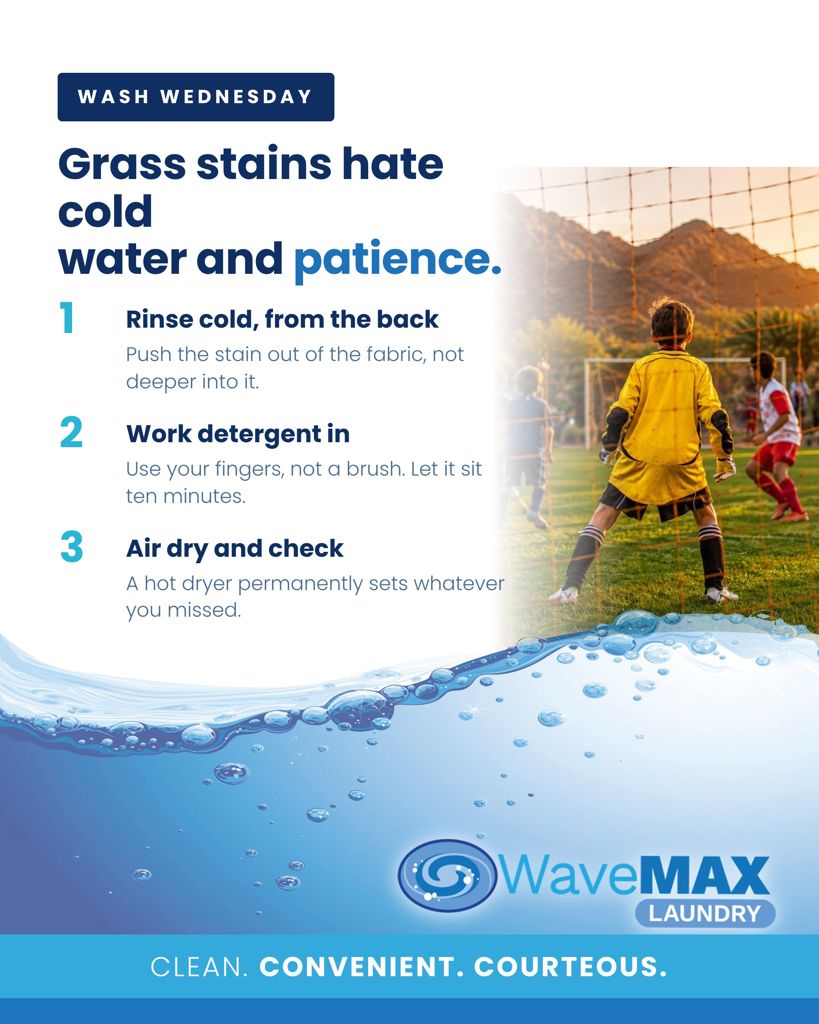
2. Check everything for stains before it goes in. Two minutes for the whole pile. Treat what you find and let it sit while you start the first load. A stain that goes through a dryer untreated is permanent, and this single habit saves more clothing than any product.
3. Start the bulkiest load first. Towels or bedding. They take the longest to dry, so they should be in the dryer while everything else is washing.
4. Uniforms and school clothes next, cold and inside out for anything dark.
5. Athletic gear separately, warm, no fabric softener.
6. Fold and put away the same day. A clean basket that sits until Tuesday gets picked through, and half of it ends up back in a hamper unworn. That is a load you paid for that nobody used.
The night-before rule
This is the habit that ends morning arguments, and it has nothing to do with washing.
Clothes for tomorrow come out the night before. All of it, including socks and shoes.
It takes three minutes at eight at night and it removes the seven-fifteen discovery that the only clean uniform shirt is in the dryer, wet.
For younger kids, five labeled bins or a hanging organizer with the week laid out on Sunday works even better. The decisions all get made once.
Where things land when they come off
Most laundry chaos is a sorting problem rather than a washing problem.
Put a hamper where clothes actually come off, which is usually the bedroom or the bathroom rather than the laundry room. Clothes end up on a floor because the hamper is somewhere else.
Three categories is the most a household will reliably maintain: lights, darks, towels and bedding. Anything more elaborate quietly collapses.
Keep a separate open basket for damp things. Wet practice clothes in a closed hamper sour fast in San Antonio, and a soured load has to be run twice.
Mesh bags for socks, a different color per kid, ends the sock problem permanently.
What goes wrong in week three
Every routine fails the same few ways. Knowing them in advance helps.
Something gets discovered late. A project shirt, a field trip, a game jersey nobody mentioned. Ask on Sunday what is coming up, rather than finding out Thursday night.
A wet load gets left in the washer. In this climate it sours in well under a day, and drying it sets the smell permanently. Do not start a load you are not around to move.
Somebody outgrows something. Check fit in the first week rather than in October. Shoes especially.
The routine gets skipped once and then twice. One missed Sunday is recoverable. Two puts you a week behind and back to weeknight loads.
Teach the kids the parts they can do
By eight or nine, a kid can sort their own clothes into three hampers and put their own folded laundry away. By eleven or twelve they can run a load start to finish.
Two rules are worth teaching early because they prevent the expensive mistakes: tell someone about a stain rather than hiding the shirt, epi never put anything stained into a dryer.
Hidden stained clothing found weeks later is the most common cause of ruined school clothes in any house.
Where the machines help
The weakness in a once-a-week routine is that it is six or seven loads through one machine, which is most of a day, and it collapses entirely if the machine goes down or a weekend gets busy.
The machines at our self-service laundry on Babcock Road run in parallel, so a full week for a whole household goes through in about the time one load takes at home. For families running the Sunday routine, doing it in one trip rather than across a whole day is what makes the routine survive September.
Nou wash-dry-fold service covers the week if things have gotten ahead of you.
The short version
Count backwards from what has to be ready each morning, then count how many of each item you own, because the answer is usually to buy one more rather than to wash more often. Pick one laundry day and empty every hamper on it whether or not it is full. Empty the bags first, check everything for stains before it goes in the machine, and start the bulkiest load first. Set clothes out the night before, keep three hampers and a separate basket for damp things, and never start a load you are not there to move.
WaveMAX San Antonio is at 1552 Babcock Rd, easy to reach from the medical center area and the surrounding neighborhoods. If the first weeks of school have the household behind, call us at (210) 236-5035.