
The baking stretch of the year is when this one comes out of the drawer. There is a tray of something going out to a gathering, somebody is filling the bag again with warm hands, and it gets rinsed between jobs because there is no time for more than that. By the third or fourth session it has started to feel different. The inside is slightly tacky, the outside has a dull patch where the seam is, and if you hold it to your nose there is a faint, stale smell of old butter. Nothing has spilled and nothing looks stained. The fat is simply still in there.
What the Bag Is Built From
A fabric piping bag is almost always cotton: canvas, drill or a close twill, cut and seamed into a cone. Cotton is used because it is strong when wet, it tolerates warm water and detergent, and it grips well enough in the hand when it is damp. The seam runs the length of the cone and the narrow end is reinforced where the tip sits.
Most of them also have a coating on the inside face. It is a thin polymer film, often polyurethane, laid onto the fabric and cured in place. Without it, untreated cotton canvas weeps. Fat and sugar syrup work their way through the weave under hand pressure and come out on the outside of the bag, which is both unpleasant to hold and impossible to clean.
That film changes the object completely. On one side you have an absorbent fabric and on the other a sealed plastic surface, bonded together. The two layers behave differently in heat, in water and under bending, and almost everything that goes wrong with these bags comes down to the two layers parting company.
There is a seam to think about as well. Along the seam the fabric is doubled and the coating has to turn a corner, so the film is thinner there and under more strain than anywhere else. The narrow end is the other weak point, since a tip is pushed in and pulled out of it repeatedly. If a bag starts leaking, it is usually at one of those two places.
Butterfat Does Not Rinse in Cold Water
Butterfat is solid at room temperature. Under a cold tap it stays solid, so the water runs over it without wetting it and carries almost none of it away. The bag looks rinsed because the loose sugar and the visible residue have gone, and it feels clean because fat on a smooth coated surface feels slick rather than dirty.
Water is also chemically unsuited to the job. Fat molecules have no charged ends, so water has nothing to grip, and the two separate rather than mix. Detergent solves that by providing molecules with one end that holds water and one that buries itself in fat, surrounding the fat in droplets small enough to be carried off. Without that, warmth alone just moves the fat around.
So the two requirements are warmth and detergent together, and both have to be real. Warm enough that the fat has softened and will flow, and enough detergent to keep every droplet suspended all the way to the drain. Half a dose in tepid water lifts fat off the surface and then lets it settle straight back onto the fabric as the water cools.
What happens with repeated cold rinsing is worse than nothing. Hand pressure and rubbing push unsoftened fat into the weave through any gap in the coating, and into the stitch holes along the seam. Each session adds a little more, further in, where no later wash will reach it.
Why an Old Bag Smells
Fat does not sit inert. Over weeks and months it breaks down, the long molecules splitting into shorter fatty acids, and those shorter molecules are volatile enough to smell. That is the whole explanation for the stale butter note in an old bag. It is not the last thing that was piped through it. It is everything that has ever been through it, slowly going off.
The reason the smell is so persistent is where the fat is. Some of it is in the cotton on the outer side of the coating, having been pressed through the weave at the seam. Some of it is in the interface between film and fabric, where the two have begun to separate. Neither place can be reached by water from the inside, because the film is in the way.
A bag that smells after a proper warm wash with a full dose of detergent is telling you something specific: the fat has got past the barrier. Nothing done from the inside will fix that, and washing the outside only reaches the surface of the cotton, not the interface. It is a structural problem disguised as a cleaning problem.
There is also a visible version of the same thing. Oxidized fat yellows, so the outer cotton develops a brownish cast in the places where fat has come through. On a pale canvas bag it shows first along the seam and around the tip, exactly where the film is thinnest.
Washing It Inside Out
Scrape before water. Turn the bag inside out over a trash can or a paper towel and take off the thick residue with a dull edge or your fingers, working from the wide end toward the tip. Whatever you remove dry is fat that never gets a chance to be driven into fabric by the water pressure.
Then wash it inside out, in genuinely warm water, with a full amount of detergent. Inside out matters because the coated face is the one carrying the soil, and because a bag washed right side out traps a pocket of air and water in the cone and the inside barely gets touched. Work the warm water right into the corner at the tip, where everything accumulates.
Keep it out of the machine, and particularly out of any machine with clothing in it. Fat transfers freely in a warm drum and will leave a thin film on every other item in the load, which then shows up as marks that will not wash out of shirts. The tumbling itself is also hard on the coating, because the film is brittle relative to the fabric and repeated flexing starts it cracking.
Heat finishes coatings off. Polyurethane film softens with heat, and softened film under pressure or friction lifts away from the fabric in patches. Dry the bag in air, inside out, propped open over something narrow so air moves through the cone, and give it longer than seems reasonable. A damp bag folded away sours, and the smell then comes from both the fat and the damp.
When the Bag Is Finished
The coating gives the clearest signal. Run a fingertip around the inside. If it feels tacky when dry, the film has begun breaking down and it is now holding fat against the fabric rather than keeping it off. If you can see it lifting, clouding, cracking or peeling anywhere, especially along the seam, the barrier is gone and fat is going straight into the cotton.
The second test is the one you do after a wash, not before. Wash the bag properly, warm, inside out, with a full dose, dry it completely, and then check it with your hand and your nose. A bag that still feels waxy or still smells of old butter has fat beyond the reach of washing, and it will keep adding that to whatever goes through it.
There is no rescue for either condition. Hotter water accelerates the coating’s failure, more detergent cannot cross the film, and soaking swells the fabric and lifts the film further. The honest answer with a bag at this stage is to stop using it for food and let the next one start clean.
The way to make a bag last is simply to never let fat set in it. Scrape, then wash warm with detergent at the end of each session rather than rinsing cold and promising to handle it later, and dry it fully open. Most bags that are thrown out were not worn out. They were cold rinsed into the ground.
Baking Bags in Mesquite This Time of Year
Mesquite kitchens get busy in these weeks in a way they are not for the rest of the year. The oven runs, trays go out of the house to gatherings, and whatever is in the drawer gets used three times in a week instead of twice in a season. A bag that would normally have time to be washed properly between uses does not get that time.
The local climate cuts both ways here. Dry air is a real advantage for drying a coated cone right through, which is the part most people get wrong, and a bag hung open in a Mesquite laundry room genuinely does dry. The heat works against you earlier in the process, because a bag left on the counter after use has warm fat spreading further into the weave while it waits.
So the habit worth building during the busy stretch is the order of operations. Scrape it out while the fat is still soft, wash it inside out in warm water with a full dose of detergent, and then take advantage of the dry air by hanging it open somewhere until it is bone dry. Put it away in a drawer the same evening and you undo all of it.
The Rest of the Baking Laundry
A coated cone belongs at the sink, but everything else a long baking session produces does not. Aprons with butter down the front, towels used for everything, and the cloth off the table all want warm water, a generous dose of detergent and more room in the drum than they usually get.
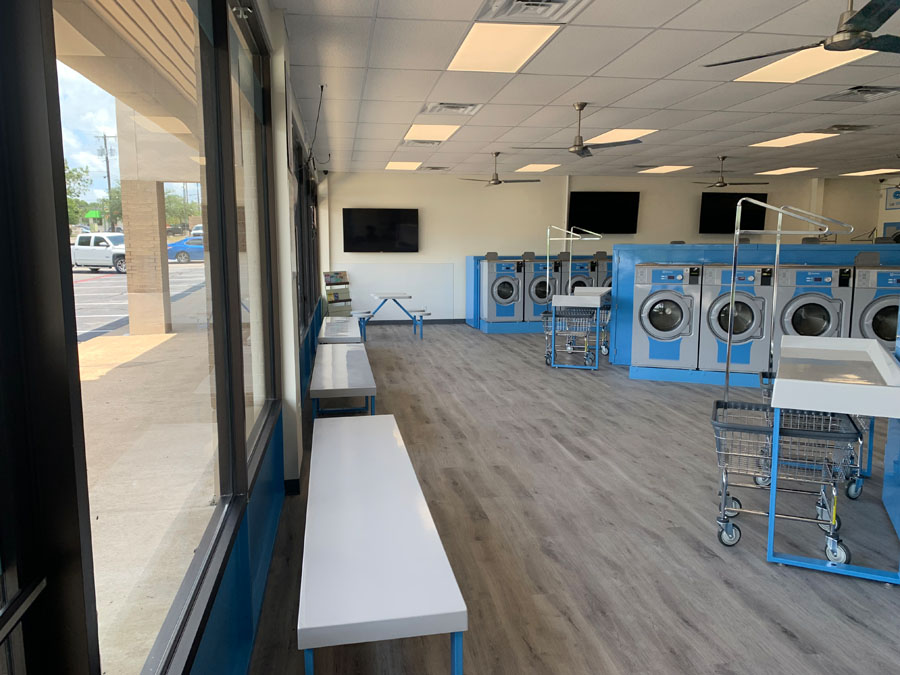
The machines at our self-service laundry on North Galloway Avenue are sized for the kind of load a busy kitchen actually makes, so aprons and towels carrying real fat can tumble freely in warm water with enough detergent around them to carry the soil out rather than redeposit it.
Our machines and the store are cleaned daily.
Nou wash-dry-fold service covers the everyday laundry.
For general guidance, The American Cleaning Institute publishes a stain removal guide that is a useful cross-check.
The short version
A reusable piping bag is cotton with a thin polymer film on the inside, and the film is the whole design. Butterfat is solid at room temperature, so cold rinsing leaves it behind and hand pressure drives it into the weave and through the seam. Warm water with a full dose of detergent, inside out, is the only wash that works. Once the film is tacky, cracked or lifting, or the bag still smells after a proper wash, the fat is past the barrier and the bag is done.
WaveMAX Mesquite is at 529 N. Galloway Ave ste. 16, easy to reach from Mesquite and the surrounding area. If you have a load that will not fit at home, call us at 214-758-0802.