
School uniforms look like they should be easy. Same three items, five days a week, no decisions in the morning. Then October arrives and the collars are curling, the navy has faded to something closer to gray, and one polo has a permanent pale patch where somebody scrubbed at a stain.
Uniform pieces get worn harder than any other clothing a kid owns. Five wears a week, five washes a week, for nine months. Regular clothes never see that. A little care changes whether the same shirts finish the year or get replaced twice.
Buy for the wash cycle, not for the fitting room
The decision that matters most happens before anything is worn.
Buy more than you think. Five polos rather than three. It sounds like more money and it is less, because each shirt goes through the machine forty percent fewer times over the year. Wash cycles are what wear clothing out, not wearing it.
Check the fabric content. A cotton and polyester blend, usually around sixty-forty, is the practical choice. All cotton is more comfortable and shrinks, wrinkles, and fades faster. All polyester holds its shape and color but breathes poorly, which matters in a Texas August when the building has forty kids in a room.
Buy one size up if a growth spurt looks likely, but not two. A shirt that hangs badly gets rejected and never worn, which is the most expensive outcome of all.
Wash everything before the first day. New garments carry sizing chemicals, they will shrink most on the first wash, and any dye that is going to run does it now rather than onto a white shirt in week three.
Collars, which fail first
The collar is what makes a polo look old, and it fails from two separate causes.
The gray line along the fold is body oil and sweat combined with dirt from the neck. It is an oil stain, so treat it like one. Work liquid dish soap or a laundry pretreat directly into the fold with your fingers, let it sit fifteen minutes, and wash in the warmest water the tag allows. Cold water does almost nothing to oil, which is why regular washing never touches this.
Do this weekly rather than waiting for it to become visible. Once it is set in, it is much harder.
Curling and warping is mechanical. Heat and tumbling do it. A polo dried on high heat every wash will have a wavy collar by Christmas.
Dry on medium or low, take it out slightly damp, and smooth the collar flat with your hand before hanging it. That single motion, which takes two seconds, keeps a collar flat for the year.
Keeping navy navy
Dark uniform colors fade, and most of the fading is avoidable.
Turn everything inside out. Fading happens through abrasion against the drum and against other garments. Turning a shirt inside out puts the wear on the inside surface.
Wash darks in cold. This is the exception to the warm water rule above. Treat the collar with warm targeted attention, then wash the garment cold to protect the color.
Do not over-dry. Heat is hard on dye. Pull things out slightly damp.
Keep them out of direct sun when line drying. Sun bleaches dark fabric surprisingly fast in this climate. Dry darks in shade or indoors.
Half a cup of white vinegar in the rinse helps set dye and removes the detergent residue that dulls color.
Common stains on a school day
Cafeteria grease and pizza. Oil. Dish soap worked in, ten minutes, warmest water the tag allows.
Marker and ink. Rubbing alcohol or hand sanitizer on a cloth, blotting from the outside of the mark inward, with a dry cloth underneath.
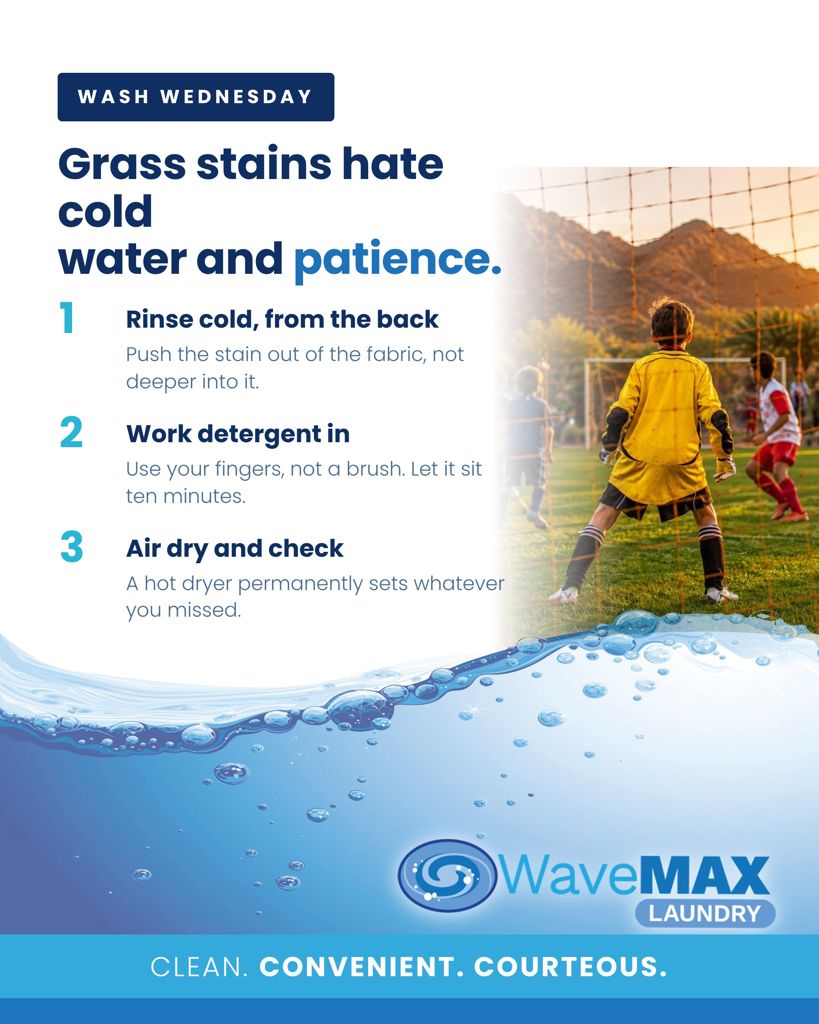
Grass and mud from recess. Grass wants immediate cold treatment with detergent and contact time. Mud wants to dry completely first so you can knock it off. Opposite approaches, and getting them backwards sets the stain.
Blood from a scrape. Cold water only. Heat makes it permanent.
Glue and paste. Most school glue is water soluble and comes out with a soak. Let it dry first, then flake off what you can.
The rule underneath all of these: do not put a stained garment in the dryer. Look at it dry, in daylight, before it goes anywhere near heat. One dryer cycle turns a recoverable shirt into a play shirt.
Pilling, and how to fix it
Those little fabric balls come from friction, and blends pill more than pure fibers because the two fiber types wear at different rates.
You cannot prevent it entirely, but you can slow it: wash inside out, avoid overloading, do not wash uniforms with towels or anything with a zipper, and skip high heat.
To fix what is already there, a fabric shaver takes five minutes on a whole stack and makes shirts look considerably newer. A disposable razor works in a pinch, held flat, worked gently.
Khakis and skirts
Bottoms last longer than tops but fail differently.
Knees and seat wear thin from friction and there is no preventing it. Rotating pairs helps.
Hems come out. Check them in the fall, because a hem caught early is a five minute repair and a hem left alone means a new pair.
Pressed creases are set with heat, so if a school expects them, iron on the appropriate setting with a damp pressing cloth rather than blasting the fabric directly.
Khaki shows everything, so treat spots the day they happen.
A routine that survives a school year
Sunday night: check every uniform piece for stains before it goes in. Treat anything you find. This one habit is worth more than any product.
Hang uniforms rather than folding them. Fewer wrinkles, no ironing, and the collar stays flat.
Keep a pretreat bottle where the laundry lands rather than in a cabinet. A stain treated in ninety seconds comes out. The same stain found Sunday frequently does not.
Where the machines help
Uniform loads are small and frequent, which is the least efficient way to run a household machine, and small loads still cost a full cycle of wear on the clothing and the machine.
The machines at our self-service laundry on Central Drive let you run a week’s uniforms for several kids in one properly sized load with room to tumble, which is gentler on the fabric than a packed home drum on a heavy cycle. Doing it in one pass on a Sunday is also less total wear than five small mid-week loads.
Our wash-dry-fold service covers uniforms and household laundry if the week gets away from you.
The short version
Buy five polos rather than three, because wash cycles wear clothes out and more shirts means fewer cycles each. Treat the collar fold weekly with dish soap and warm water, since that gray line is body oil and cold water will not touch it. Wash the garments themselves cold and inside out to protect dark color, dry on low, and smooth the collar flat before hanging. Never dry a stained shirt, and check every piece on Sunday night before it goes in the machine.
WaveMAX Bedford is at 2301 Central Dr, easy to reach from Bedford, Euless, and the surrounding area. If uniforms have gone dingy and you want to know whether they can be brought back, call us at (817) 494-1599.