
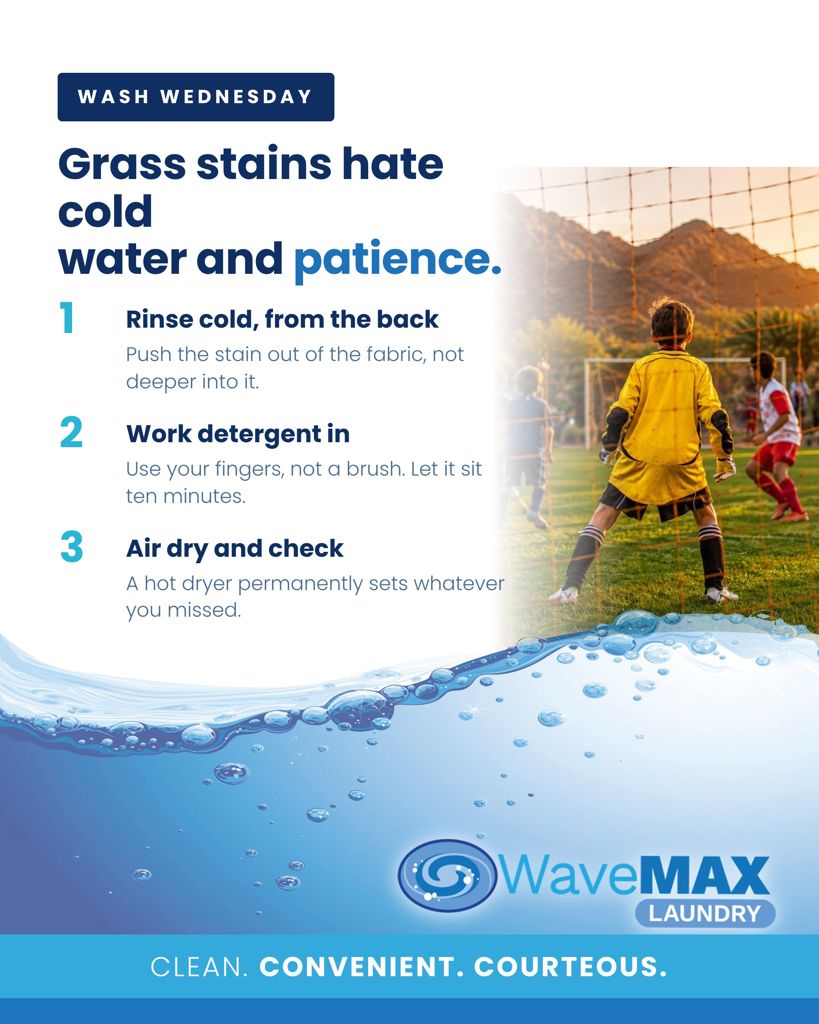
Somebody ends up doing the team’s laundry. Sometimes it is a rotation among parents, sometimes it is one person who volunteered in August and regretted it by October, and sometimes it is a coach with a machine in a closet at the school.
Whoever it is, they are doing something different from household laundry. Twenty-five identical jerseys is not a big version of a normal load. It is a different problem with different failure modes, and the mistakes are expensive because they happen to every uniform at once.
Get the rules in writing before the season
Uniforms are frequently school property, and the person who ruins them is the person holding them.
Ask the coach or the athletic director three questions: who owns these, what does the manufacturer’s care tag say, and is there a program policy. Then follow the tag rather than habit.
Photograph the tags at the start of the season. Tags come off, and a stack of anonymous jerseys with no care instructions is how a set gets ruined.
Count them and write the number down. Do it every time. Uniforms disappear between the field and the wash.
Sort by number, wash by color
Two habits that make the whole job manageable.
Lay them out in number order before washing. You find out immediately if something is missing, while there is still time to ask about it, rather than in November when a kid has no jersey for a game.
Wash home and away sets separately, always. White and dark in the same load is how a set of white jerseys goes gray in one wash, and there is no undoing it across twenty-five garments.
Do not mix in towels or practice pinnies. Towels shed lint that clings to polyester mesh permanently.
The mistakes that ruin a whole set at once
Overloading. The big one. Twenty-five jerseys in a household washer cannot move, so water never gets through them and detergent stays trapped in the middle. What comes out is uniformly badly washed. Better to run three proper loads than one packed one.
Too much detergent. The instinct with a big dirty load is more soap. On performance fabric, excess detergent does not rinse out, and the residue holds odor and stiffens the mesh. Use less than the cap says and run an extra rinse instead.
Fabric softener. Never on athletic fabric. It coats the fibers, blocks the moisture-wicking the fabric exists for, and seals body oil and bacteria in against the fiber. One softened load affects the uniforms for the rest of the season, because the coating does not come off in a normal wash.
High heat. Heat destroys the elastic, cracks screen-printed numbers, and shrinks anything with cotton in it. Numbers and logos are the part that cannot be replaced. Low heat or hang dry.
Chlorine bleach on whites. It yellows polyester rather than whitening it, and it destroys any spandex in the fabric. Oxygen bleach instead.
The sequence that works
1. Turn everything inside out. The inside is where the body oil is, and that surface should face the water. It also protects the numbers from abrasion.
2. Treat visible stains individually before anything goes in. Grass wants cold water and detergent with contact time. Mud should be dried and knocked off first. Blood is cold water only, always. Do this on a table, one at a time, and it takes fifteen minutes for a whole set.
3. Soak the whole set in warm water with white vinegar, one part to four, for thirty minutes. This is where most of the odor removal happens and it is the step people skip.
4. Wash warm with enzyme detergent, less than the recommended amount, in loads small enough to tumble freely.
5. Extra rinse. Every time.
6. Check them wet. Smell them and look at them before anything is dried. Heat sets both odor and stains permanently, and a set that goes through a dryer with a problem is a set with a permanent problem.
7. Hang or dry low. Then count them again as you fold.
Timing, which is most of the difficulty
The uniforms come off after a game and go into a bag. That bag sits somewhere. The longer it sits, the worse everything gets, and this is the single largest variable in how a set ages over a season.
Ask that the uniforms come to you the same day rather than at the next practice. A bag of damp jerseys sitting three days is a bag of sour jerseys, and running them twice is more work than collecting them promptly.
If they arrive damp and you cannot wash them immediately, take them out of the bag and spread them out. Air is free and it stops the clock.
Build in a buffer. Uniforms needed Friday should be washed by Wednesday, because something always goes wrong and a machine breaking on Thursday night with no margin is how a team plays in practice shirts.
Keeping track of what is yours
Numbered jerseys sort themselves. Everything else does not.
Warmups, practice gear, and socks get a laundry marker on the care tag with the number rather than the name, since gear gets reassigned between seasons.
Keep a written inventory with numbers and sizes. Hand it to whoever takes over next season, because otherwise the counting starts from zero every year.
Note damage as you find it. A small tear at a seam is a repair. The same tear in October is a replacement.
Where the machines make this practical
A full set of uniforms is genuinely more than a household machine can do properly. Running three or four sequential loads plus dryer time is most of a day, every week, for one volunteer.
The machines at our self-service laundry on West Diversey run in parallel with drum sizes built for this, so an entire team’s uniforms go through at once with room to tumble rather than packed. The soak step also actually works, because there is enough water in the drum for the solution to circulate through everything.
Our wash-dry-fold service handles a full set if the rotation has fallen to one person.
The short version
Photograph the care tags and count the jerseys at the start and end of every wash. Never mix home and away sets. Do not overload, since a packed drum washes nothing properly, and use less detergent with an extra rinse rather than more. Never fabric softener, never high heat, and never chlorine bleach on polyester. Treat stains individually before the load, soak the set in vinegar and warm water, wash warm with enzyme detergent, and inspect everything wet before it sees any heat.
WaveMAX Chicago is at 4830 W Diversey Ave, easy to reach from the northwest side and the surrounding neighborhoods. If you have taken on a team’s laundry and want to talk through the first wash, call us at (773) 853-0246.